Trade edition · 2026
UNICITY
Information-Theoretic Authorization
Frank Dylan Rosario and Dr. Lin Wang
UNICITY asks whether an observation changes justified belief about a hidden object under a named model, then carries Shannon's secrecy ruler from messages to authorization transcripts.
Abstract
A first-draft book on copied authority objects, Shannon's secrecy ruler, transcript secrecy, anti-unicity, and the Rosario / ENI6MA construction. Measurement and argument, not implementation guidance, legal advice, or a deployment warranty.
For forty years the internet has treated possession as authority. If you can present the password, the token, the card number, the API key, or the recovery code, the system treats you as the person who may act. UNICITY is a book about that design choice. It begins with Claude Shannon's 1949 standard of perfect secrecy: the condition in which seeing the ciphertext does not update an observer's belief about the message. From the one-time pad, entropy, mutual information, and unicity distance, the book builds a ruler for a different question. What object crosses the wire when a system grants access? What does a passive observer learn by recording it? Can the recorded object be reused as authority?
This site does not host the manuscript. Product protocol documentation lives at eni6ma.com and is not theorem evidence.
A different way of proving identity
UNICITY asks whether an observation changes justified belief about a hidden object under a named model, then carries Shannon's secrecy ruler from messages to authorization transcripts.
Possession as authority
Most systems treat possession of a copyable artifact as authority. If a verifier accepts the password, the token, the card number, or the API key, a later holder of a copy can present the same object. UNICITY is a book about that design choice.
Shannon's ruler
Claude Shannon's 1949 standard of perfect secrecy is the condition in which seeing the ciphertext does not update an observer's belief about the message. UNICITY carries that ruler from messages to authorization transcripts: it asks whether an observation changes justified belief about a hidden object under a named model.
What a verifier observes
Under that named information-theoretic model, a verifier can check a scoped authorization outcome without the observed transcript updating belief about the hidden authority object the way a static credential does. The verifier observes a pass/fail or other scoped check. The verifier does not receive the secret material outside the defined protocol.
Scope of the claim
The claim is measurement and argument in a first-draft book. It is not implementation guidance, legal advice, or a deployment warranty. It is not a claim that a product or deployment is perfectly secure.
Annotated contents
Condensed from the prospectus. Seventeen chapters: Shannon first, then a named construction after Chapter 11.
Front matter
Preface, notation guide, and glossary. Shannon terms first. Named-construction vocabulary is withheld until Part II.
Chapter 1. Shannon Before Authorization
Separates possession of a copyable artifact, authorization as a permission decision, and transport security. States how to read scoped claims.
Chapter 2. Silicon Speed and the Hidden Crisis
Human-era expiry versus machine copy speed. Transport can hide a token in flight and still deliver a static credential into memory and logs.
Chapter 3. Shannon's Perfect Secrecy
Defines I(M;C)=0. Teaches the one-time pad as existence proof, then names its logistics. Computational security is placed beside that standard, not as a synonym.
Chapter 4. The Workshop Floor of the One-Time Pad
XOR, Bayes, entropy, and mutual information as operations. Failure modes, especially key reuse.
Chapter 5. The Unicity Distance
Source of the title. Spurious keys, redundancy, and u ≈ H(K)/D. A properly used pad does not collapse because key entropy grows with the message.
Chapter 6. The Padlock Illusion
TLS attests a named channel, not authorization of the next action. A strong pipe can still carry copyable authority.
Chapter 7. The Computational Bargain
Why the web accepted hardness instead of emptiness. Semantic security as a polynomially bounded cousin of Shannon's claim.
Chapter 8. Quantum and Post-Quantum Context
Harvest-now-decrypt-later. Post-quantum migration hardens transport. It does not, by itself, change authorization cargo.
Chapter 9. The Revolution
1976 as lineage and as compromise. The public-key revolution distributed keys. It did not claim an empty authorization transcript.
Chapter 10. What Would Have To Change?
Pivot without naming a stack. The object on the wire changes from ciphertext hiding a message to the authority-carrying artifact.
Chapter 11. Changing the Axioms
First reveal. Channel Zero is defined as I(X;O∣C)=0 under stated assumptions. Zero-knowledge is placed as neighbor, not substitute.
Chapter 12. Channel Zero
Geometry on the wire. Hidden state stays local; published bearings keep uniform marginals under the model.
Chapter 13. The Doorless Server
Systems architecture demanded by empty transcripts: outbound subscription, burn-before-validate, compile-time permission graphs.
Chapter 14. The Six-by-Six Matrix
Comparison tool across authorization metric, network profile, secrecy layer, quantum posture, replay, and proof-object lifecycle.
Chapter 15. Anti-Unicity and Transcript Archives
Under the stated model, an archive of bearing witnesses does not shrink uncertainty about the hidden map.
Chapter 16. The Observer's Ledger
Surface bits versus effective bits. Recording is not learning when secret-relevant mutual information stays at zero under the model.
Chapter 17. The Sixth Primitive
Closes on the architectural thesis: authorization without an exportable token, scoped to the transcript and the stated assumptions.
Back matter
Formal reference appendix, Shannon 1949 teaching companion (reprint rights not obtained), notes, bibliography, and index.
Imprint and identifiers
Rosario Cybernetics is the publisher of this volume and the research imprint behind it. The imprint's work here is research and publication on information-theoretic authorization. The measured questions are what an observed transcript can teach about hidden authority state, and whether a copy of that transcript still authorizes in a later context.
- Publisher: Rosario Cybernetics
- Paperback ISBN 979-8-9980466-6-7
- EPUB ISBN 979-8-9980466-5-0
- 540 Howard St, San Francisco, CA 94150
- Site: rosariocyber.com
Coming soon to Amazon and Kindle. Audiobook expected 2027. No retail buy link is published until a listing exists.
Press kit
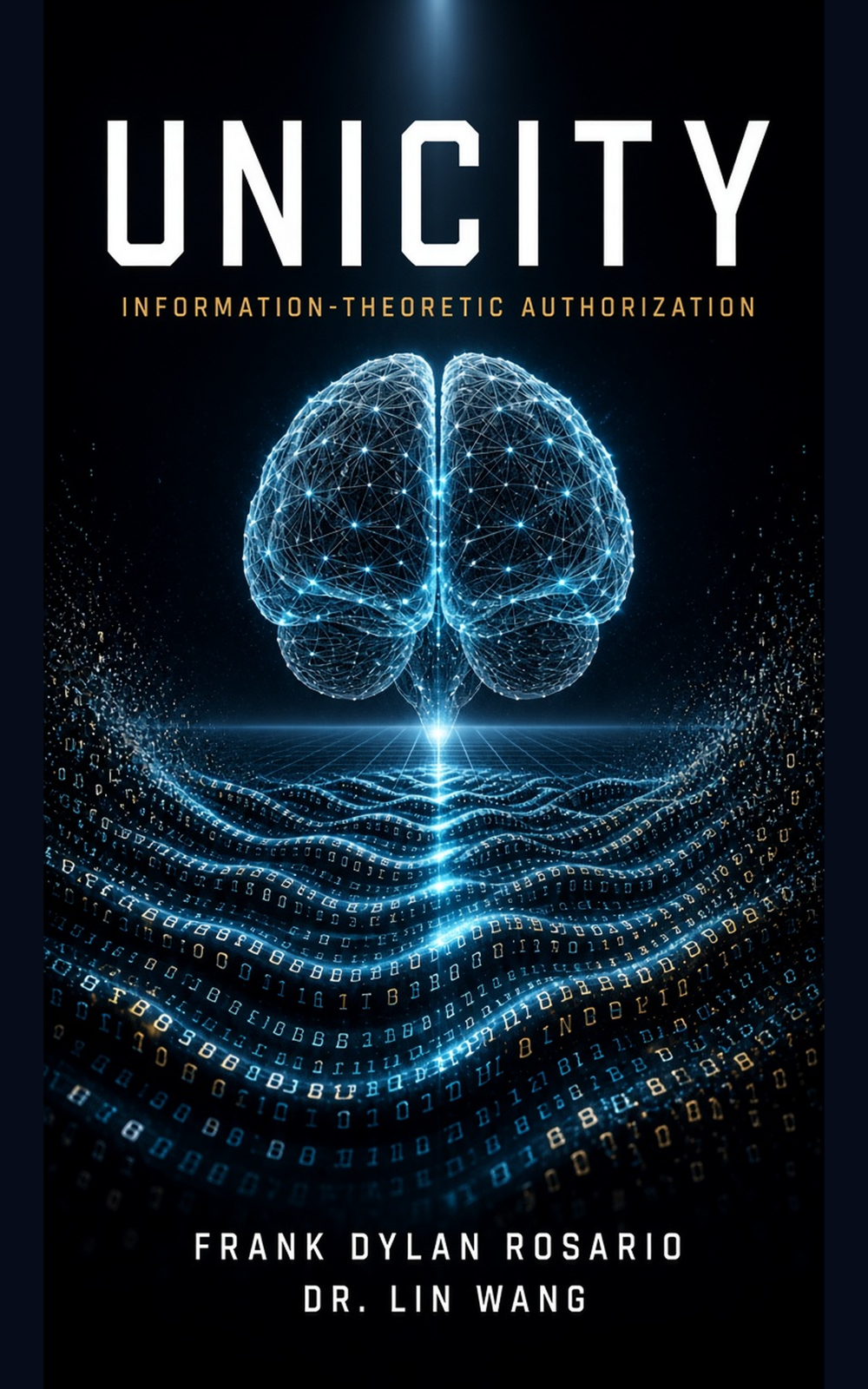
Cover art is provided for identification. Title, subtitle, and authors on the painted cover are unproofed model lettering; use the HTML type on this site or the identifiers below. Authors: Frank Dylan Rosario and Dr. Lin Wang.
- Cover image (web hero)
- Open Graph card (1200×630)
- Author bio: homepage and about
- Press and imprint mail: contact
